 Coinlist
 token sales use separate rules for wallet funding and token allocation
· updated
Coinlist token sales require a purchase request or bid under the selected sale’s allocation rules, so funding a self-custody wallet alone does not secure tokens. Identity verification and offering eligibility govern participation. The sale then assigns tokens through its stated mechanism, which may use submission order, bottom-up allocation, or an auction clearing price. A funded wallet provides spending capacity; an allocation determines the accepted purchase, and the distribution schedule determines when the tokens become available.
The wallet supplies funds while the sale assigns an allocation
A self-custody wallet holds the assets used to pay for a sale, while the allocation mechanism determines how much of a purchase request succeeds. The embedded wallet gives its owner control over funds and private keys. Coinlist supplies the interface, eligibility screening, and allocation infrastructure. The issuer offers the tokens under its own terms, and transfers occur between that third party and the participant’s wallet or account.
Verification and offering terms govern participation
Token-sale participants must complete Know Your Customer and Anti-Money Laundering checks, commonly called KYC/AML, before participating in the offering. These checks apply to both US and non-US residents. The required verification level follows the sale’s eligibility conditions, and jurisdiction restrictions can prevent participation even after account verification. A funded wallet does not satisfy either of these requirements.
Payment information appears after token-sale registration, and participation may require affirmative acceptance of separate issuer agreements. Those agreements govern the purchase and any associated rights or restrictions. Registration provides access to the sale’s payment information; it does not assign a token allocation.
Stablecoin purchase funds and ETH gas cover different expenses
The Ethereum token-sale payment flow accepts USDC or USDT for the purchase and requires ETH to cover network gas. These balances satisfy separate funding requirements. Holding enough stablecoins to meet the purchase amount does not establish that the wallet can also pay the transaction fee.
Purchase value
The token-sale payment terms count each unit of USDC or USDT as one US dollar, regardless of stablecoin price fluctuations. The new embedded wallet interface supports Ethereum mainnet only; a supported asset sent over an unsupported network will not appear in that interface.
Transaction gas
An insufficient ETH balance causes a transaction in the Ethereum token-sale payment flow to fail. Gas pays for network execution. The ETH requirement follows the transaction’s gas requirement, a separate expense from the minimum purchase amount.
Coinlist cannot reverse or modify a blockchain transaction, so a completed transfer to the wrong destination cannot be undone through an account adjustment.
Submission order decides first-come, first-served allocations
A first-come, first-served sale selects allocations in submission order until its token supply runs out. Participation requires KYC approval and the minimum purchase amount in USDC or USDT. Once the sale opens, participants submit purchase requests. For this structure, a request cannot exceed the stablecoins held in its funding wallet.
Having enough funds establishes the capacity to submit the request; funding earlier does not replace submitting it when the sale opens. A request that arrives after supply is exhausted receives no allocation.
Bottom-up allocation gives each participant an equal initial amount
Filling from the Bottom distributes allocations evenly from the lowest amounts upward, giving participants an equal initial amount before progressively filling larger requests. This water-filling mechanism seeks to accommodate more individual participants while allowing larger expressions of demand. A larger funded request does not automatically receive its full requested allocation. The available sale supply constrains how far the mechanism can fill those requests. This allocation rule operates differently from submission-order priority, so the same purchase demand can produce a different accepted amount.
The Zama auction rules linked allocations to a clearing price
The January 2026 Zama sale terms specified a sealed-bid Dutch auction with a demand-based price cutoff for token allocations. Its scheduled bidding window ran from January 21 to January 24, 2026.
Confidential bids and finite sale supply
The auction design used fully homomorphic encryption, or FHE, to keep bids confidential during onchain operation. Bid confidentiality did not remove the identity-verification requirement. Its terms allocated 880,000,000 tokens to the sale, representing 8% of the total token supply. The rules called for ranking bids by price, highest first, after bidding ended. The price at which allocated tokens reached the supply limit would set the clearing price. Its published minimum purchase amount was $100.
Allocation around the clearing price
Bids above or at the cutoff
The rules provided full allocations for bids above the clearing price. Bids exactly at that price could receive partial allocations. The purchase amount and bid price therefore addressed different constraints: one expressed the amount committed, while the other determined the bid’s position relative to the auction cutoff.
Bids below the cutoff
The January 2026 Zama auction rules excluded bids below the clearing price from token allocations. Those bids qualified for a full refund under the sale’s terms.
A funded bid can still fall below the auction cutoff
In a hypothetical application of the January 2026 Zama rules, an eligible participant commits 248 USDC to a bid priced below the eventual clearing price and holds sufficient ETH for gas.
Under the sale’s stablecoin payment convention, 248 USDC equals $248, exceeding the $100 minimum by $148. The bid price remains below the cutoff, however, so the allocation outcome is zero tokens. The rules make the full 248 USDC bid amount refundable.
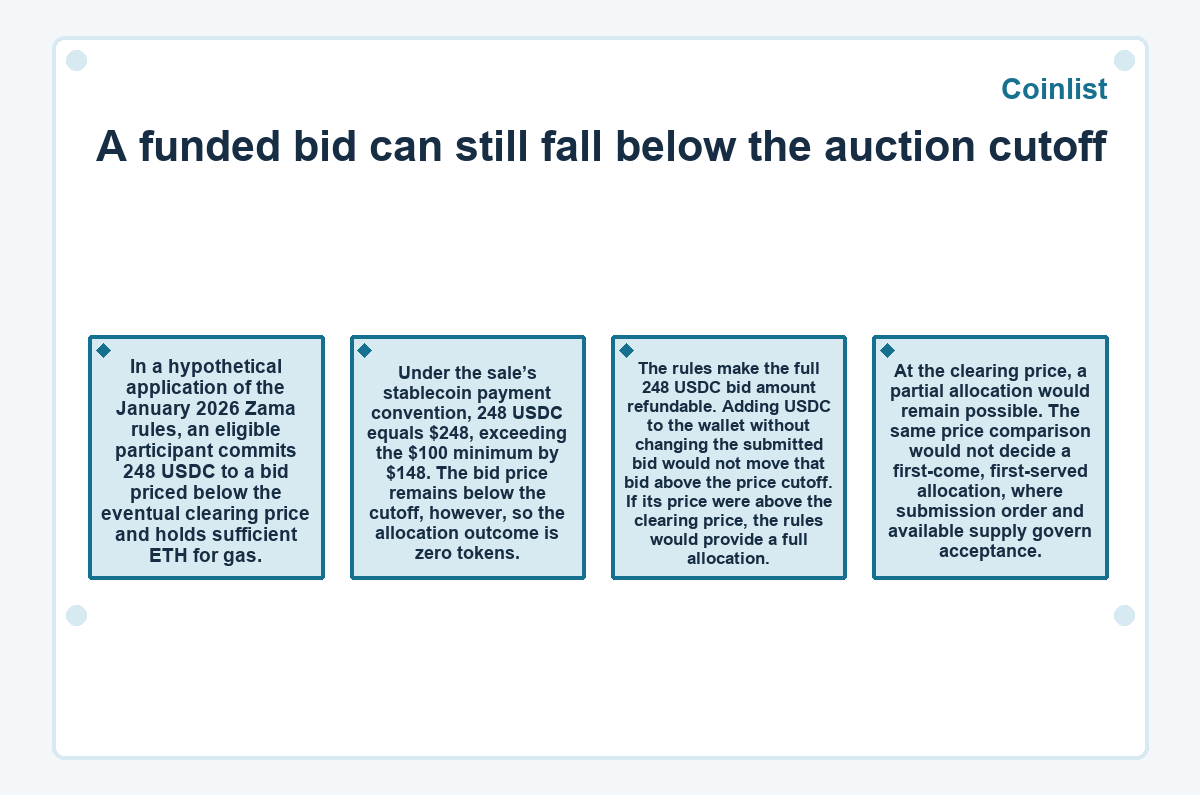
Adding USDC to the wallet without changing the submitted bid would not move that bid above the price cutoff. If its price were above the clearing price, the rules would provide a full allocation. At the clearing price, a partial allocation would remain possible. The same price comparison would not decide a first-come, first-served allocation, where submission order and available supply govern acceptance.
Sale refunds and legacy withdrawals move funds for different reasons
A sale refund returns purchase funds following an unsuccessful allocation, while a legacy withdrawal moves assets out of the deprecated custodial platform. The general token-sale refund provision specifies a return to the funding wallet within five business days of the sale’s conclusion. That timing starts from the conclusion of the sale, not from the initial wallet deposit.
The five-business-day provision addresses users who receive no allocation. A bid with a partial allocation represents a different outcome. The Zama terms allowed partial allocations at the clearing price; the treatment of any unused purchase funds follows the applicable offering terms.
Transferring earlier custodial USDC or USDT balances into the new self-custody wallet counts as a legacy withdrawal, and standard legacy withdrawal fees apply. Supported legacy holdings may have a Transfer option; other holdings use withdrawal to an external address. These migration arrangements move existing assets without submitting purchase requests for a new token sale.
The new wallet’s total balance reflects supported assets in the non-custodial wallet. It does not combine every old custodial holding with newly transferred purchase funds.
An allocation remains subject to distribution and unlock terms
An allocation establishes the purchase accepted under the sale’s mechanism; the offering’s distribution schedule and unlock conditions govern when the tokens become available. The non-custodial model supports delivery into wallets that participants control. That changes where tokens arrive without removing the issuer’s release terms. The January 2026 Zama auction listed February 2, 2026 as its unlock date, a schedule specific to that offering.
Token availability also differs from the ability to sell or transfer immediately. Offering terms can impose transfer restrictions, and limited liquidity can prevent a sale when the holder wants one. Where a sale includes an unlock schedule, an accepted allocation alone does not establish that the tokens are already available for unrestricted use.
Things people ask about Coinlist
-
Why might a verified account need to repeat identity checks before joining another Coinlist sale?
- Identity re-verification refreshes due diligence records and checks whether account activity and risk classifications remain appropriate. A previous verification does not prevent a later review. Completing the requested process restores access affected by that review. The offering’s separate eligibility restrictions still apply.
-
How quickly does a submitted sale payment appear in the purchase interface?
- A submitted token-sale payment may take a few minutes to appear in the purchase interface. That display delay does not establish an allocation or a failed payment. A payment becoming visible does not itself confirm a token allocation.
-
Can I create another account if I lose authenticator access before a token sale?
- Coinlist does not accept duplicate accounts as a way to recover lost authenticator access. An account backup code can restore access if one remains available. Without usable backup codes, recovery requires support assistance on the original account. Creating another account will lead to closure of the duplicate and does not resolve the original account’s authentication problem.
-
Do previous Karma tiers still establish token-sale priority?
- The Karma program is paused, and its future structure has not been finalized. Coinlist retained snapshots of users’ Karma histories and tiers during the non-custodial transition. Those records preserve past activity without specifying new sale-priority rules.
-
Who pays the fees associated with a token sale?
- Participants, issuers, tokenization providers, distribution partners, or other parties may pay service fees or compensation under the applicable arrangement. The payer and amount can vary with the product, jurisdiction, user type, and integration. These charges differ from Ethereum network gas and from withdrawal fees on legacy assets.
-
Will the non-custodial transition cancel tokens from an earlier sale that have not unlocked?
- The custody transition preserves entitlements to previously held tokens, including tokens awaiting distribution or unlock. Their delivery method can differ by token and network, with instructions provided as distributions occur. This entitlement does not establish immediate availability or a common delivery date for every asset. Pending sale distributions remain separate from the supported balance visible in the new wallet.