 Coinlist
 staking wind-down and final reward payouts
· updated
Coinlist staking ended as a custodial service, with November 30, 2025 as the cutoff for the specified final reward payouts. The affected programs covered autostaking and onchain offers. Remaining legacy balances require separate review because the new self-custody wallet displays only supported assets that it holds.
Bottom line: Legacy USDC and USDT transfers incur withdrawal fees even when the destination is the new self-custody wallet.
Former autostaking enrollment and onchain offer participation
Before the wind-down, final rewards covered enrolled autostaking assets and assets in the former onchain offers. The specified autostaking assets were AXL, SOL, CSPR, and SUI. The onchain-offer group included LBTC, USDe, weETH, and wstETH. Holding one of these assets after the wind-down does not establish earlier enrollment or offer participation. Enrollment or offer participation determines which discontinued program belongs in a payout review.
Once you can access the existing account, inspect the affected token’s legacy balance and transaction history. Check whether a final reward is recorded as paid, keeping withdrawals and migrations separate from that payment. You can stop after reviewing these records without moving funds.
| Former program or balance | Payout or holding | Access method | Condition or limit |
|---|---|---|---|
| Autostaking: AXL, SOL, CSPR, and SUI | Final rewards paid by November 30, 2025 | Legacy balances and account records | Custodial program wound down |
| Onchain offers: LBTC, USDe, weETH, and wstETH | Final rewards paid by November 30, 2025 | Legacy balances and account records | Coinlist offer programs wound down |
| Legacy USDC or USDT | Existing stablecoin balance | Transfer option on the Wallet page | Legacy withdrawal fees apply |
| Other legacy assets | Remaining token holdings | Transfer for supported assets; Withdraw for others | Embedded wallet displays supported assets on Ethereum mainnet only |
When did Coinlist pay the final staking rewards?
Coinlist paid final rewards for the specified autostaking and onchain-offer assets by November 30, 2025. Staking and onchain offers also wound down by that date. Leaving a balance on the legacy platform afterward does not extend the discontinued reward schedule.
Coinlist announced its non-custodial transition on November 17, 2025, before the final payout cutoff. Its January 13, 2026 onchain-sale announcement described the new wallet model as active.
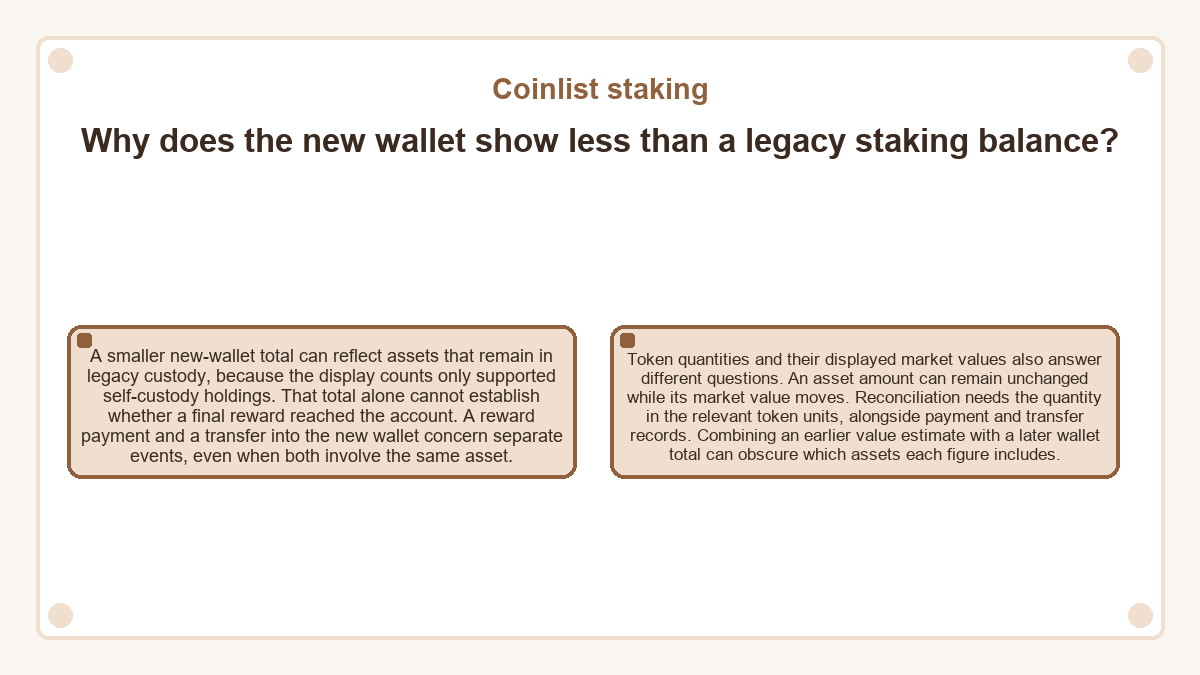
Why does the new wallet show less than a legacy staking balance?
A smaller new-wallet total can reflect assets that remain in legacy custody, because the display counts only supported self-custody holdings. That total alone cannot establish whether a final reward reached the account. A reward payment and a transfer into the new wallet concern separate events, even when both involve the same asset. Token quantities and their displayed market values also answer different questions. An asset amount can remain unchanged while its market value moves. Reconciliation needs the quantity in the relevant token units, alongside payment and transfer records. Combining an earlier value estimate with a later wallet total can obscure which assets each figure includes.
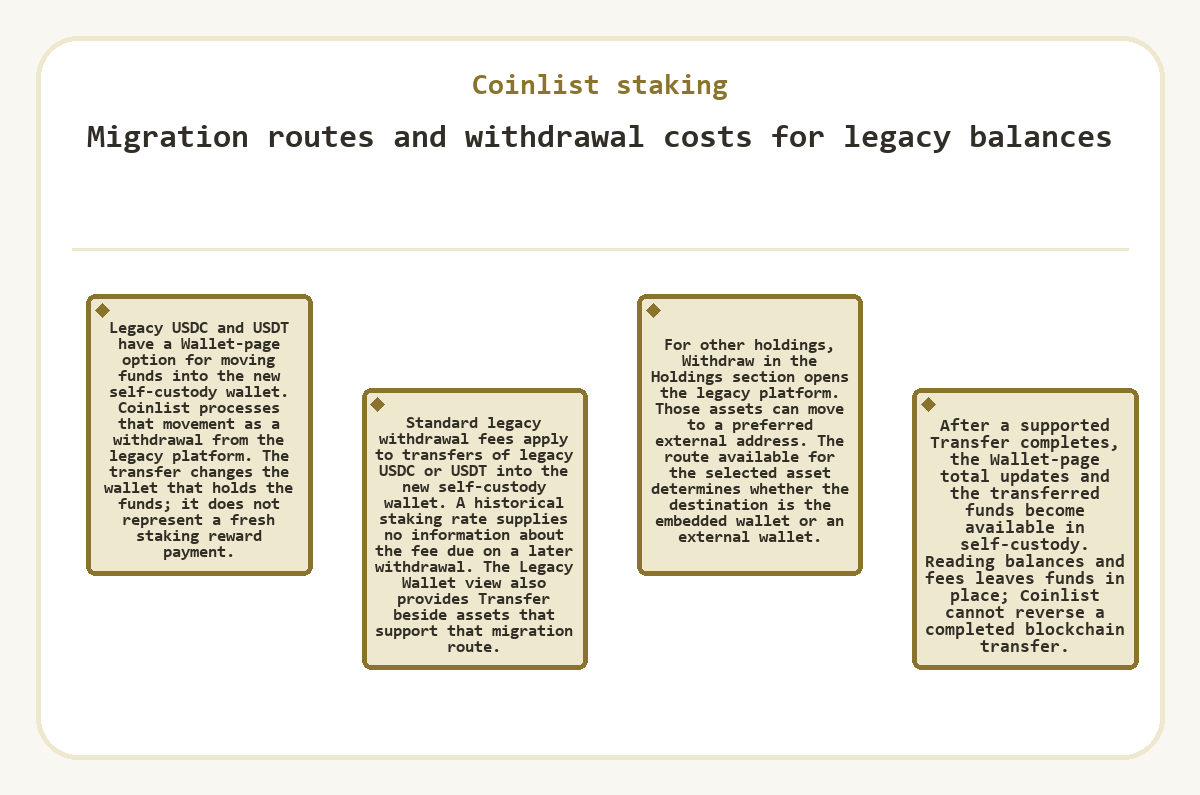
Migration routes and withdrawal costs for legacy balances
Legacy USDC and USDT have a Wallet-page option for moving funds into the new self-custody wallet. Coinlist processes that movement as a withdrawal from the legacy platform. The transfer changes the wallet that holds the funds; it does not represent a fresh staking reward payment.
Standard legacy withdrawal fees apply to transfers of legacy USDC or USDT into the new self-custody wallet. A historical staking rate supplies no information about the fee due on a later withdrawal.
The Legacy Wallet view also provides Transfer beside assets that support that migration route. For other holdings, Withdraw in the Holdings section opens the legacy platform. Those assets can move to a preferred external address. The route available for the selected asset determines whether the destination is the embedded wallet or an external wallet. After a supported Transfer completes, the Wallet-page total updates and the transferred funds become available in self-custody.
Reading balances and fees leaves funds in place; Coinlist cannot reverse a completed blockchain transfer.
Does the self-custody wallet keep the old staking programs running?
Holding assets in the self-custody wallet does not continue the retired custodial staking or onchain-offer programs. The wallet provides an address and balance for supported holdings. Users control its private keys, and Coinlist cannot move those funds on their behalf. The embedded wallet interface currently supports Ethereum mainnet and a defined list of assets. AXL is listed for Ethereum mainnet; SOL, CSPR, and SUI are absent from the supported list. A supported token balance in this wallet does not, on its own, establish participation in a new reward offering.
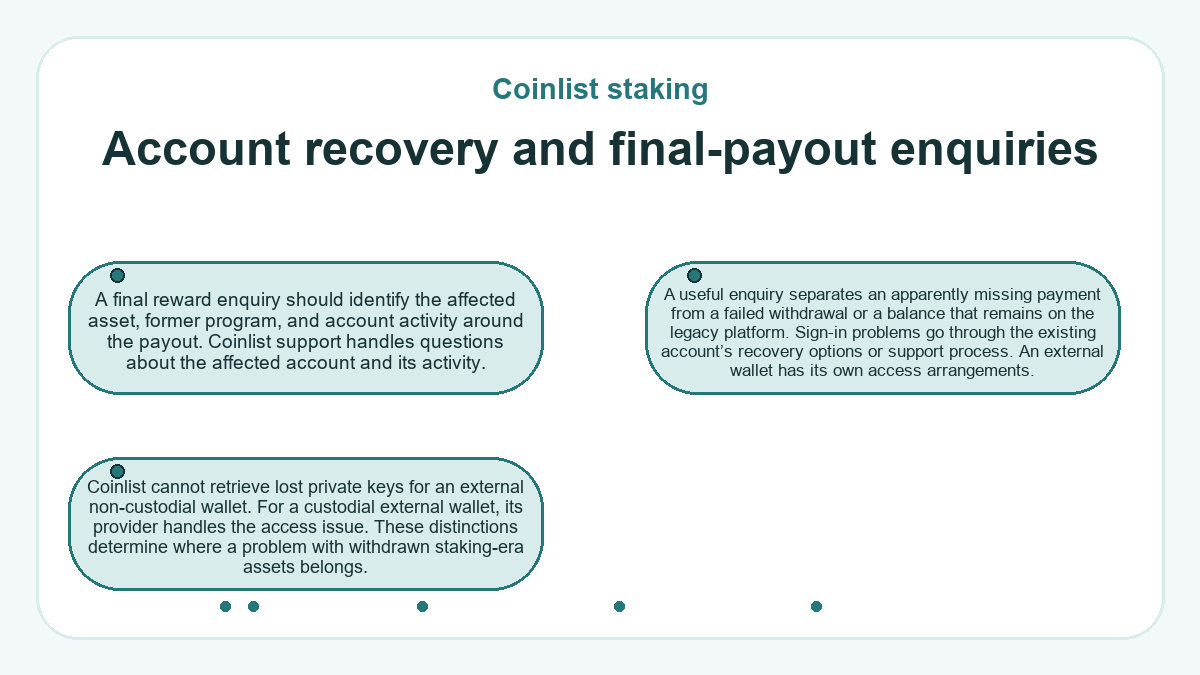
Account recovery and final-payout enquiries
A final reward enquiry should identify the affected asset, former program, and account activity around the payout. Coinlist support handles questions about the affected account and its activity. A useful enquiry separates an apparently missing payment from a failed withdrawal or a balance that remains on the legacy platform.
Sign-in problems go through the existing account’s recovery options or support process. An external wallet has its own access arrangements. Coinlist cannot retrieve lost private keys for an external non-custodial wallet. For a custodial external wallet, its provider handles the access issue. These distinctions determine where a problem with withdrawn staking-era assets belongs.
Karma and planned reward products after the wind-down
Coinlist paused Karma during the transition and retained snapshots of users’ history and tiers. It had not finalized the program’s future structure. The transition also included plans for non-custodial ways to access similar opportunities. Those plans did not extend the retired staking and onchain-offer programs. Previous Karma tiers do not reopen enrollment in them.
Popular questions about Coinlist staking
Can I move a legacy SOL or SUI staking balance into the new embedded wallet?
The new embedded wallet does not list SOL or SUI among its supported assets. Its interface supports Ethereum mainnet, while SOL and SUI belonged to the former autostaking group. Legacy holdings without a supported Transfer route use Withdraw to access the legacy platform and move assets to an external address.
Should a support ticket about final staking rewards include my private key?
Coinlist never asks for your private key to investigate final rewards. A ticket can identify the account, affected asset, and disputed activity without sharing wallet credentials. Anyone who obtains the private key can control the wallet’s funds, and Coinlist cannot recover lost wallet keys.
How can I regain access to final staking records after losing my authenticator device?
An unused account backup code can restore sign-in access after loss of the authenticator device. Without usable backup codes, the support process handles authenticator recovery. Continue with the original account, since Coinlist does not permit duplicate accounts. Restoring account access does not recover a lost external-wallet private key.
Why might Coinlist request new identity documents before I can inspect a legacy staking balance?
Coinlist can require identity re-verification to refresh due-diligence records and reassess account-risk classifications. An outstanding verification request can restrict platform access. Follow the existing account’s instructions to restore access restricted by re-verification. Coinlist’s FAQ also permits withdrawals if you decline that check. The final staking payout cutoff does not cancel ongoing identity requirements.
Are pending token-sale unlocks included in the final staking payout?
Pending token-sale distributions remain separate from final staking rewards. The transition preserved ownership of previously held tokens, including tokens awaiting distribution or unlock. Delivery methods can differ by network, and token-specific distribution instructions govern access. November 30, 2025 was the staking wind-down cutoff, not a universal unlock date for sale tokens.
Does closing my Coinlist account end access to a wallet holding former staking assets?
A digital asset wallet may remain usable through its wallet provider after Coinlist account closure, under that provider’s terms. Account access and continued wallet use have separate requirements. Coinlist cannot retrieve or reset wallet credentials, so closing or recovering the platform account does not restore lost wallet keys.